[Article] - Nouvelles expériences à haut débit pour une recherche accélérée en métallurgie
Ce résultat est le fruit d’une collaboration importante entre l’IJL, le SIMAP, le LEM3, mais aussi l’ESRF avec lequel l'équipe développe le Long Term Partnership « CombiMet ».
Résumé
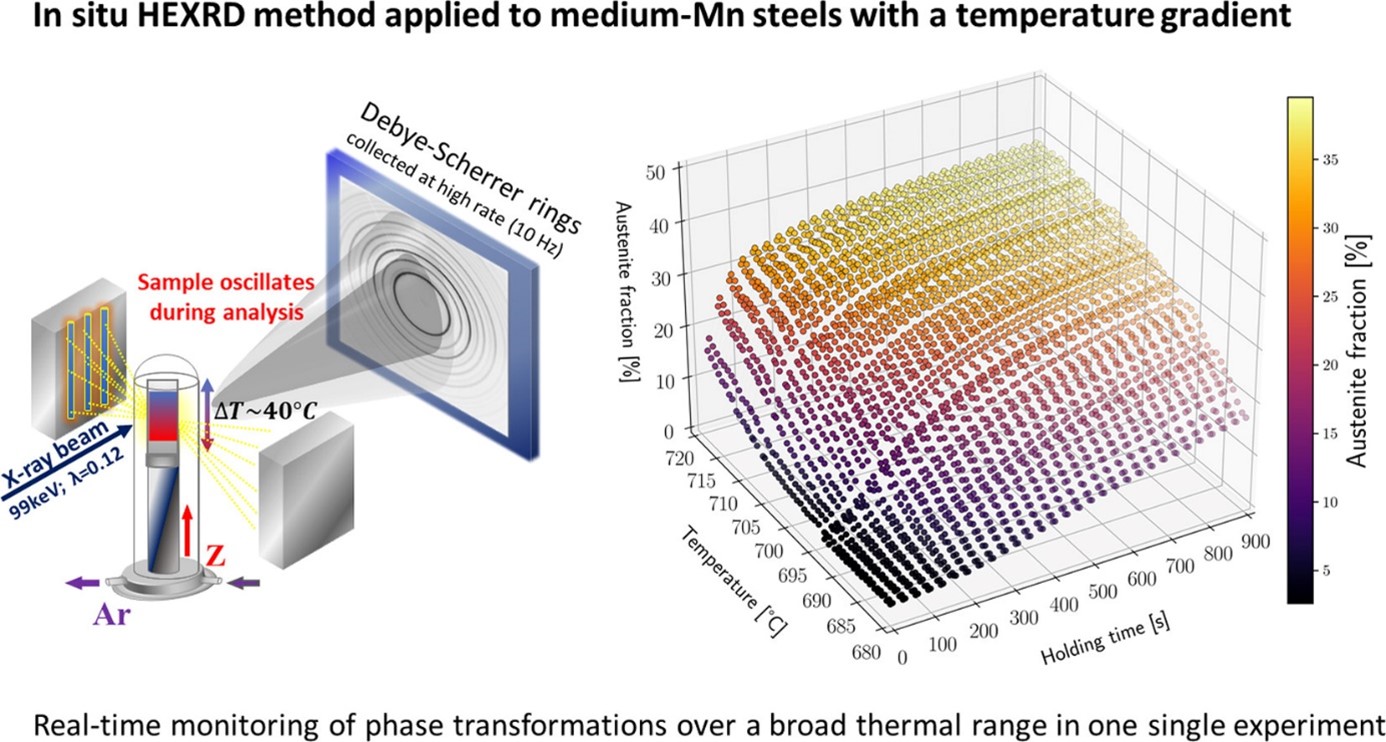
This study introduces a novel combinatorial approach for optimizing the microstructure of duplex medium-manganese (Mn) steels by coupling a controlled thermal gradient with in situ high-energy X-ray diffraction (HEXRD) during intercritical annealing. A temperature gradient (680–720 °C) across a single sample enables real-time monitoring of phase transformations over a broad thermal range in one experiment. Compared to isothermal trials, this method offers high-resolution insight into austenite formation kinetics and phase stability, enabling accurate identification of the optimal temperature window for maximizing retained austenite. The results reveal a narrow optimal range (∼700–710 °C) where retained austenite fractions exceed 30 %, surpassing values from traditional methods. Post-mortem Electron Backscatter Diffraction (EBSD) analysis showed the spatial distribution of stabilized austenite, highlighting the complementary roles of in situ and ex situ characterization. This work demonstrates the potential of gradient-based combinatorial metallurgy to accelerate process optimization and support the design of high-performance third-generation advanced high-strength steels.
Auteurs
Olha Nakonechna, Benoit Denand, Imed-Eddine Benrabah, Guillaume Geandier, Lionel Germain, Hugo Paul Van Landeghem, Alexis Deschamps, Sébastien Allain
Références
Scripta Materialia, Volume 270, 2026, 116955,
DOI