Humidity and CO₂: understanding to capture better
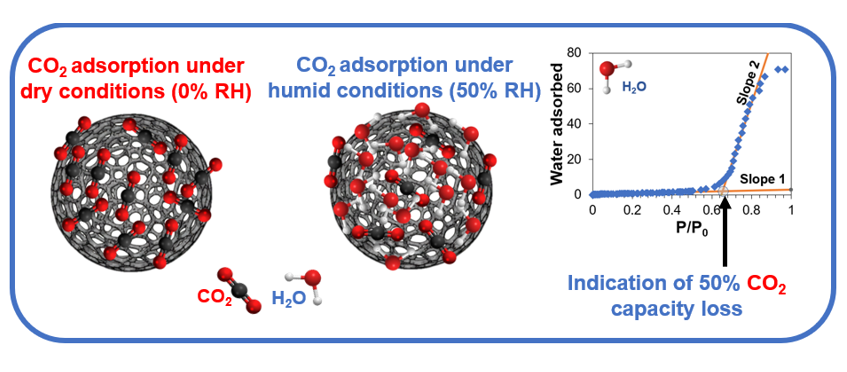
This study shows that water adsorption measurements can be used to predict how activated carbons—porous materials with a high surface area—behave when capturing CO₂ in humid conditions. The researchers demonstrate that this loss in performance can be anticipated simply by studying water adsorption, without the need for numerous complex experiments involving CO₂ under varying humidity levels.
A key finding is that a 50% loss in CO₂ capture capacity can be directly predicted from water adsorption measurements alone. The team established a link between the behavior of water and the physicochemical properties of the materials, making it possible to: (i) rapidly test new activated carbons; (ii) avoid time-consuming and costly experiments; and (iii) design more efficient materials that are more resistant to humidity. Finally, this approach could be extended to other types of materials and contribute to improving CO₂ capture technologies.
This work was carried out by Rafael Morales, a postdoctoral researcher, and Monica Aoun as part of her PhD. Both are members of the “Bio-based Materials” team at IJL in Épinal.
Title: Understanding and predicting CO2 capacity loss in activated carbons under humid conditions
Authors: R. Morales-Ospino, M. Aoun, J. Castro-Gutiérrez, Maria Teresa Izquierdo, Vanessa Fierro, Alain Celzard
Reference: Chemical Engineering Journal, 2026, 246, pp.120891.
Online publication date: 23/01/26