[Article] - Observation of the writing of a manetic bit by ultrafast transfers of magnetization between two layers
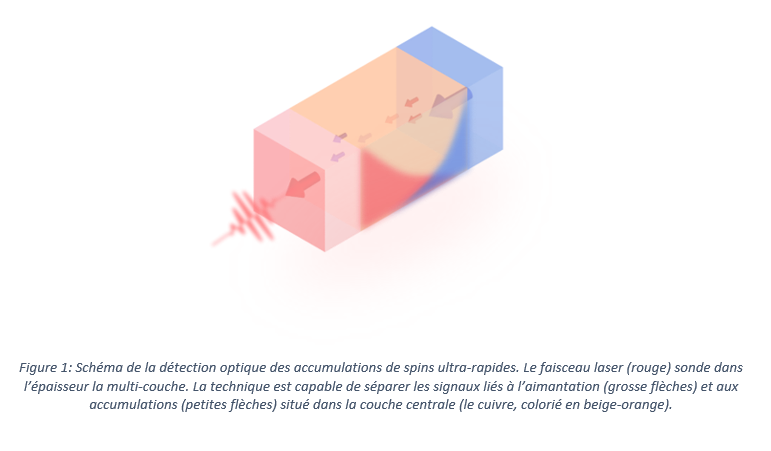
In this study, researchers used ultrashort laser pulses (on the order of femtoseconds, or one millionth of a billionth of a second) to generate and detect spin accumulations within a copper layer, which is naturally non-magnetic. To do this, the researchers fabricated structures containing two magnetic layers separated by a copper layer and excited and probed these structures using laser beams. In a 2023 study [Igarashi et al., Nat. Materials 2023], they demonstrated that in these structures, an ultrafast heat input from the laser could reverse the magnetization of one of the magnetic layers in less than 1,000 femtoseconds—a way to write information extremely quickly in a memory device.
In this new work, the researchers show that in the same structures, significant spin accumulations are generated in the copper layer following the heating and cooling of the magnetic layers. Indeed, the ultrafast heating of the magnetic layers demagnetizes them, and part of the lost magnetization is then transferred to neighboring layers via spin currents. The injection of spins into the copper layer leads to their accumulation, which diffuse until they reach the distant magnetic layer, ultimately influencing its magnetic orientation. Curiously, this effect can reverse as the magnetic layer re-magnetizes from its laser-induced demagnetized state, potentially dictating the final state of the distant magnetic layer. It is this reversed mechanism that the researchers have highlighted for the first time.
To reach this conclusion, the researchers developed an innovative optical method over the past few years for detecting spin accumulations, all at ultrafast timescales. By using complementary magneto-optical measurements (static and dynamic Kerr rotation and ellipticity), the researchers can infer a quantity proportional to spin accumulations. Combined with numerical simulations of spin diffusion and s-d magnetic dynamics, the researchers attributed the reversal mechanism to ultrafast re-magnetization currents.
This discovery opens new possibilities for controlling magnetization at ultrafast timescales through a simple and universal mechanism. Additionally, the newly developed magneto-optical methods should enable direct observation of spin and/or orbital angular momentum (magnetization) transfers in more systems, all at ultrafast timescales.
Title: Ultrafast Spin Accumulations Drive Magnetization Reversal in Multilayers
Authors: Harjinder Singh, Alberto Anadón, Junta Igarashi, Quentin Remy, Stéphane Mangin, Michel Hehn, Jon Gorchon, and Gregory Malinowski
References: Phys. Rev. Lett. 136, 056701 – Published 2 February, 2026
DOI: https://doi.org/10.1103/z2sz-2tdz