[Article] - Study of the viability of calcifying bacteria of the genus Bacillus pseudofirmus in the ultra-alkaline environment of various Portland cement pastes in order to fill autonomously micro-cracks.
• Bacillus pseudofirmus enabled calcite mineralization on 3 pure cement pastes
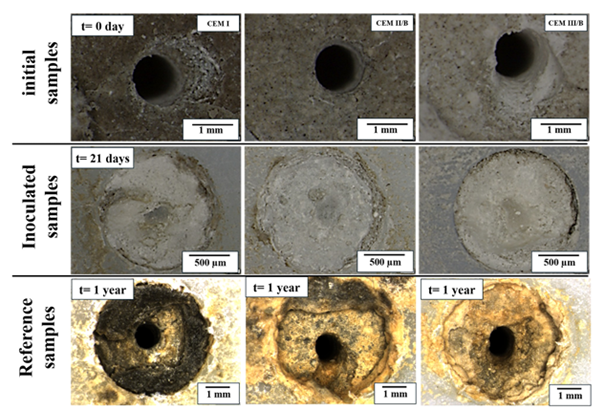
• Bacillus pseudofirmus enabled the complete filling of 9 mm3 holes in cement pastes in 21 days
• The bio-induced precipitation of calcite leads to the coating of bacterial cells
Abstract
Micro-cracks in concrete cause aesthetic inconvenience and can induce possible forms of deterioration. In this context, the present work discusses an autonomous process to fill surface micro-cracks using a bacterial bio-mineralisation process. Indeed, the Bacillus Pseudofirmus bacteria can develop carbonate bio-deposition while developing in high pH environment that is not dissimilar to the cementitious material one. The objective of this work is to study the possibility for this bacterial strain to develop bio-deposition on different cementitious cements (CEM I, CEM II, CEM III). The question is whether the deposits develop and are capable of filling a hole in the various cements, how long it takes them to do so, and what quality of carbonates they form in terms of mineralogy and deposit structure. The results show the development of bio-deposition in all three cementitious environments. The bacterial strain was found to be capable of filling a hole of 1 mm diameter in less than 3 weeks. Compared to a laboratory environment (Petri dish with agar) it was noted that carbonated phases (calcite, Mg-Calcite, etc.) can include impurities which come from soluble elements of the cement while the structure of the deposition is also different.
Autors
S. Roux, M. Lejeune, J.-M. Mechling, B. Luzu, S. Chanut
References
Case Studies in Construction Materials, Volume 24 (e05770), 2026
DOI