Simulation of turbulent lithium transport in fusion reactors
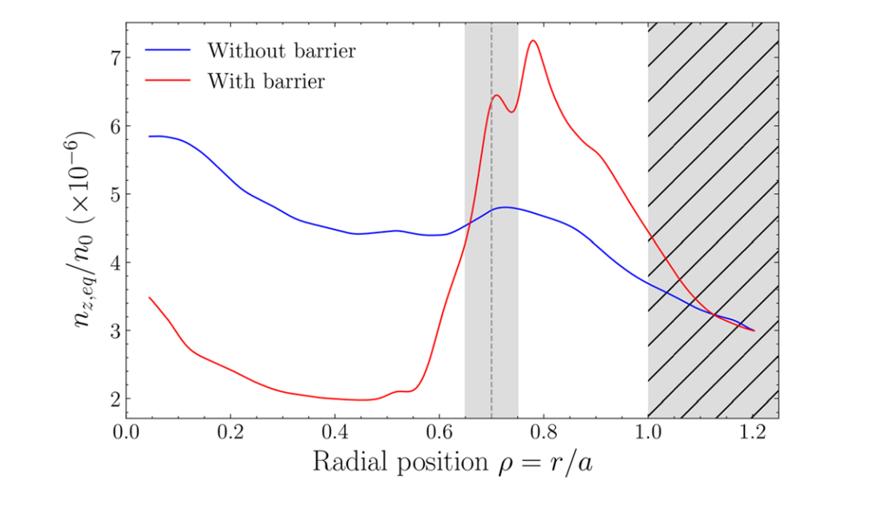
Although modern fusion devices consider the use of lithium as a plasma-facing component, its transport mechanism remains under-investigated, being different from those of heavy impurities such as tungsten. For lithium and other light impurities, turbulent transport dominates over neoclassical contributions, motivating a dedicated study on the determination of turbulent diffusion, thermodiffusion, and convective pinch velocity. In this work, we benchmark a new method to extract these coefficients using the global full-f gyrokinetic GYSELA code. In the absence of a transport barrier, the method reproduces results consistent with helium, showing that thermodiffusion is comparable in magnitude to both diffusion and pure convection. Introducing an ExB shear layer to form a transport barrier modifies the radial structure of the transport coefficients. Transport levels decrease in the inner core, while within the barrier, convection becomes dominant, and all fluxes undergo sign reversals. Diffusive and thermodiffusive contributions are also found to partially compensate each other depending on local gradients. Finally, an evaluation of the peaking factor further demonstrates that the presence of a transport barrier significantly mitigates core impurity accumulation.
Title: Global gyrokinetic study of lithium core turbulent transport with and without transport barrier.
Authors: Romain Avril, Etienne Gravier, Kyungtak Lim, Guillaume Lo-Cascio, Yanick Sarazin, Xavier Garbet, Maxime Lesur, Timothé Rouyer, Achilleas Evangelias, Francesco Volpe, Jérôme Moritz
References: R. Avril et al. Phys. Plasmas 33, 032302 (2026)
DOI: https://doi.org/10.1063/5.0316178