[Article] - Carbon nanomaterial substrates enable the growth of thin films with enhanced surface for energy applications
Abstract
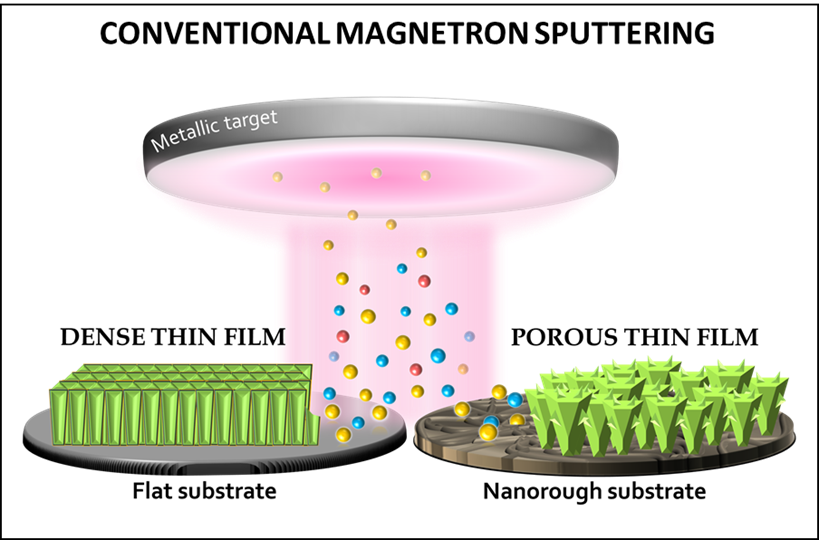
Magnetron sputtering is a versatile and scalable technique that enables the precise tuning of key properties, including crystalline phase, stoichiometry, and phase ratios. Despite its widespread use in producing dense non-porous coatings on flat substrates, its potential for developing porous electroactive materials remains underexplored. Here the use of rough substrates, such as carbon nanotubes and nanosheets, revealing a dramatic change in the growth mechanism of this model systems, nickel nitride, and chromium nitride is investigated. The nanometric roughness of these carbon nanomaterials leads to distinct effects, including strong shadowing of deposited species and non-competitive growth. This results in enhanced porous thin films with open microstructures and high available surface areas. It is then apply the experimental findings, confirmed by Monte Carlo simulations, to other thin films to demonstrate this approach extends to multiple nanorough substrate/thin film systems, thereby paving the way for designing new materials with enhanced energy conversion and storage performance.
Autors
Brigitte Vigolo, Emile Haye, Jérôme Muller, Zafar Hussain Ibupoto, Salah‐Eddine Benrazzouq, Mauricio Pavía, Alexis Carlos García-Wong, Aneela Tahira, Umair Aftab, Pavel Moskovkin, Abdul Rahman Mohamed, Aurélien Besnard, David Pilloud, Sylvie Migot, Jaafar Ghanbaja, Mélanie Emo, Noé Watiez, Amine Achour, Camille Douard, Sorin Vizireanu, Gheorghe Dinescu, Stéphane Lucas, Thierry Brousse, Jean‐François Pierson
References
Advanced Functional Materials, inPress, pp.e22071
DOI