[Article] - Hot corrosion of a nickel-based alloy in presence of molten sulfate deposits
Abstract
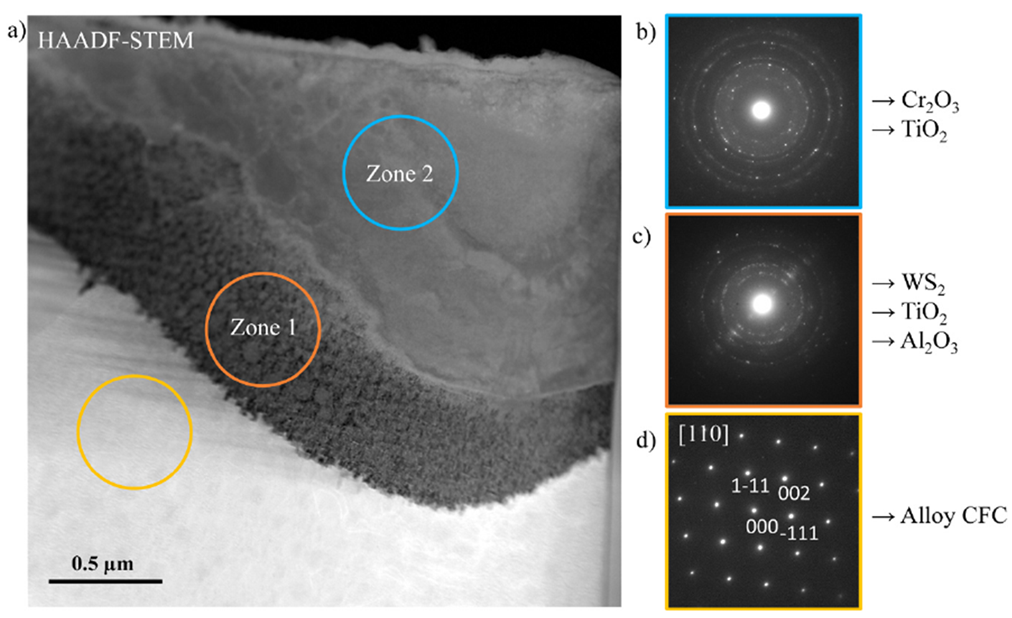
The type II corrosion resistance of AD730 was studied at 650 °C and 700 °C in air + 400 ppm SO2 (g), in the presence of Na2SO4 and Na2SO4-MgSO4 deposits. At 650◦C, the pit-like attacks were of similar depth for both salts and less severe than those observed at 700◦C. Although the sulfate mixture (Na2SO4-MgSO4) was liquid at 700°C from the beginning of the exposure, it proved to be less aggressive than Na2SO4. Wavelength dispersive spectrometry characterization of the pits revealed the systematic stratification of the oxides from the alloy corrosion products interface toward the corrosion products-gas interface across the pit corrosion products, i.e. the establishment of a gradient of oxygen ions activity. High resolution transmission electron microscopy highlighted a high level of porosity, sulfur enrichment as well as the presence of the WS2 sulfide, with an anisotropic bidimensional structure, located at the alloy-oxide interface. Sulfation tests carried out on nickel oxide and cobalt oxide in the presence of Na2SO4 and Na2SO4-MgSO4 showed little sulfation with the magnesium-containing salt, thus demonstrating how MgSO4 contributes to limit the corrosion at 700°C. The results demonstrated that the severe hot corrosion attacks are not only related to the formation of a liquid phase, but also to its chemical composition.
Autors
D. Diomande, P.J. Panteix, S. Migot, J. Ghanbaja, L. Aranda, C. Clément, M. Vilasi, S. Mathieu
References
Corrosion Science 261 (2026) 113592
DOI
https://doi.org/10.1016/j.corsci.2026.113592