[Article] - Understanding the microstructural evolution of superalloys under applied stress
Ni-based superalloys are widely used in aeronautical and industrial gas turbines because of their excellent mechanical properties at high temperatures. Their performance strongly depends on their microstructure, which consists of γ′ precipitates embedded in a γ matrix. Under mechanical loading at high temperature, this microstructure can undergo directional coarsening, known as « rafting », which can significantly affect the mechanical properties of the material.
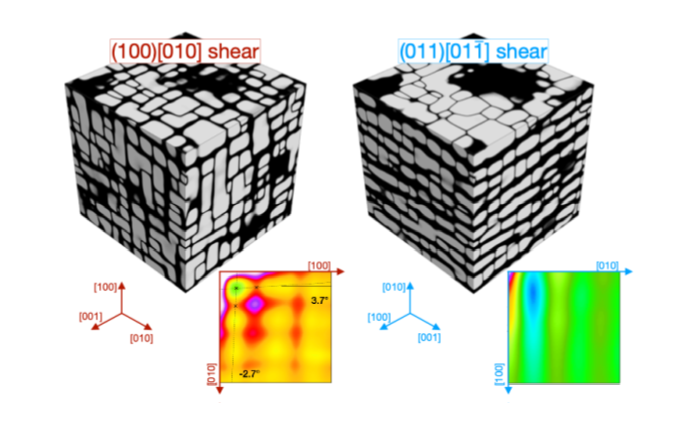
In this study, a 3D phase-field model coupled with a dislocation-density-based crystal plasticity framework is used to investigate the microstructural evolution of Ni-based superalloys under shear creep loading. Under (100)[010] shear, the microstructure largely retains its initial cuboidal morphology, with only minor rotations of the precipitate/matrix interfaces and precipitate alignments. In contrast, under (011)[011 ̅] shear, the model predicts the formation of rafts oriented such that the remaining channels correspond to those in which the primary slip systems are most active. These results are consistent with experimental observations.
The contribution of elastic inhomogeneity to these microstructural changes is also investigated using both phase-field simulations and analytical approaches. In addition, this work demonstrates the relevance of 3D spatial autocorrelation functions for the statistical analysis and quantitative characterization of simulated microstructures in Ni-based superalloys.
Title: Microstructure evolution during shear creep loading in Ni-base superalloys
Authors: M. Cottura, B. Appolaire, A. Finel, Y. Le Bouar
References: Microstructure evolution during shear creep loading in Ni-base superalloys, Acta Materialia 313 (2026) 122274.