[Article] - When Activated Carbon Turns into a Pollution Sensor
Abstract
Gas sensors play a vital role in monitoring air quality across a wide range of applications, including industry, transport and healthcare. This article study investigates the nitrogen dioxide (NO2) sensing capability of four commercial activated carbons (ACs), including two coal-based (MSC 30 and CW 30) and two bio-based (A supra and PK1-3) ACs at room temperature (25 °C). The ACs exhibited distinct textural properties, with specific surface areas ranging from 916 to 2233 m2g-1.
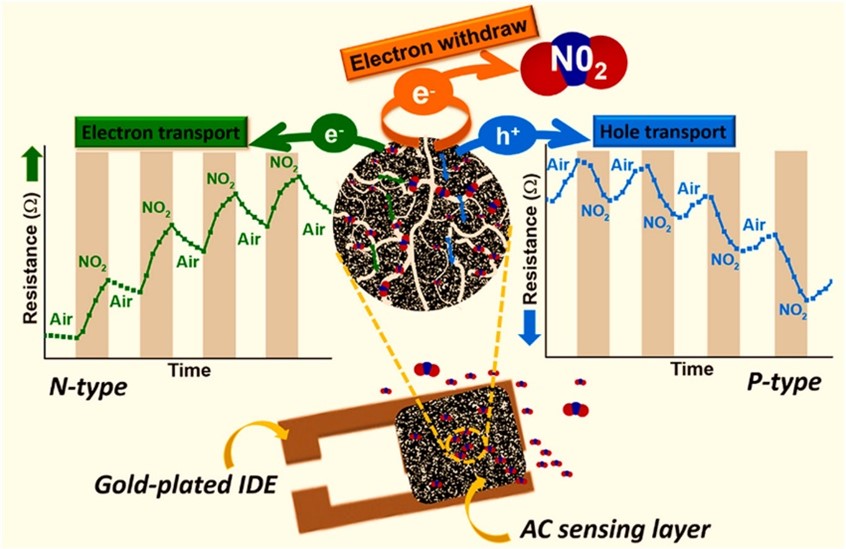
Key sensing parameters including responses, R and Rci (%), response time, recovery time, sensitivity, linearity, repeatability, reversibility and stability were examined under controlled NO2 exposures. The fabricated sensors were exposed to continuous cycles of varying NO2 concentrations, from 1 to 10 ppm, in 1 ppm increments, and from 1 to 20 ppm in 5 ppm increments. The sensors exhibited p- or n-type conduction behavior, depending on the AC, confirmed by Mott-Schottky measurements. Reversible sensing was governed by weak physical interactions (physisorption) of NO2 gas on the sensor surface and charge transport via charge hopping. These findings offer valuable guidance for selecting appropriate materials in the development of high-performance, room temperature AC-based NO2 sensors, which are an essential component of effective environmental monitoring.
This study highlights distinct NO₂ sensing behaviors of activated carbon materials at room temperature. Contrary to the prevailing assumption, unmodified activated carbons exhibit either p-type (A Supra, PK1-3) or n-type (MSC 30, CW 30) semiconducting behavior toward the same gas. These differences are attributed to variations in surface chemical states, which govern the interaction mechanisms with NO₂.
This work was carried out by Proscovia Kyokunzire in our laboratories as part of her doctoral contract.
Autors
Proscovia Kyokunzire, Jean Zaraket, Maria Teresa Izquierdo, Vanessa Fierro, Alain Celzard
References
Carbon, 2026, 246, pp.120891.
DOI
https://doi.org/10.1016/j.carbon.2025.120891